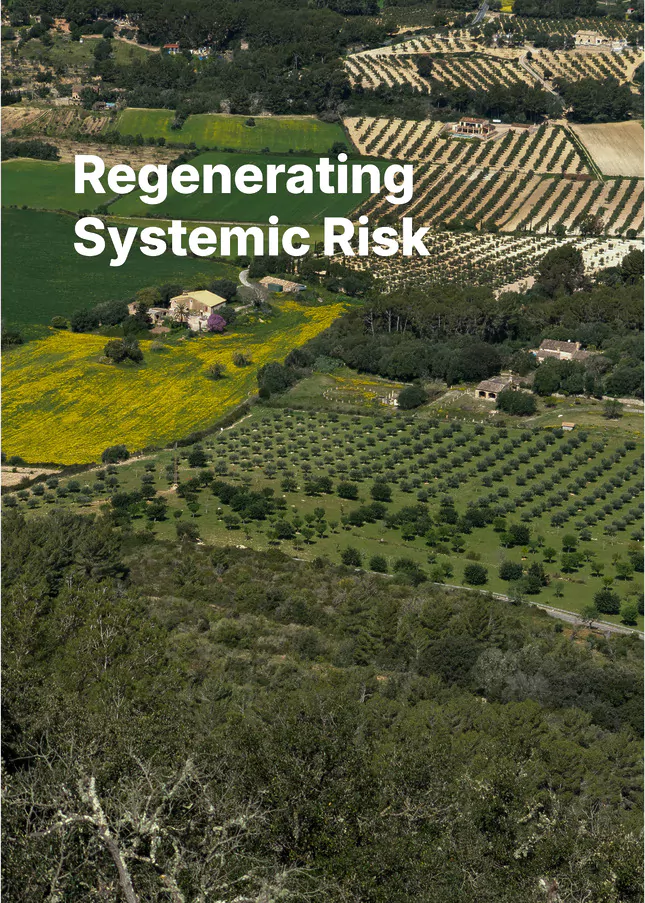
This case study examines how systemic risk arises from degraded landscapes with reduced hydrological functions, manifesting as amplified droughts, desertification, and floods. Using the October 2024 Valencia flood catastrophe as its context, the report analyses the potential contribution of regenerating forms of agriculture to flood mitigation across 316,000 hectares of agricultural land, an exercise rarely undertaken at this scale.
Regenerating Systemic Risk: Valencia Case Study
Published 8th May 2026
Read & Download | Public Sector Brief or Private Sector Brief
On October 29, 2024, parts of the Valencian Community received more than 400mm of rainfall in under 24 hours. The resulting floods caused over 230 fatalities and recovery demands exceeding €30 billion. While the rainfall was exceptional, the severity of damage was compounded by a systematically degraded landscape whose capacity to regulate water had been substantially reduced through decades of conventional agricultural management, bare soils, heavy tillage, synthetic input dependency, and the absence of year-round vegetative cover.
The report draws on two complementary methodological approaches: a Curve Number hydrological analysis estimating runoff potential across Valencian soils and land uses, and a literature-based assessment of documented improvements in soil hydrological function under regenerative management.
Together, these provide an indicative picture of what a landscape-scale transition could mean, both for events like October 2024, and for the more frequent moderate-to-severe rainfall events that already occur regularly.
Under current conventional management, approximately 86% of a 200mm rainfall event becomes surface runoff. Introducing permanent cover crops between orchard rows reduces that figure to around 58%, corresponding to over 100 billion litres of additional water retained in soil across Valencia’s perennial crop systems.
Systems under regenerative agriculture for over 3-4 years could further reduce the total runoff to 46%. This equates to more than 776,000l per hectare or 212 billion litres total of extra water absorbed and retained within the soil over the entire rainfall event.
Reactive measures do not promise long-term security for the increased probability of climate shocks. Without addressing the underlying causes, infrastructure will prove in time wholly inadequate.
The Cost of Inaction Is Compounding
Every year of delay in transitioning agricultural land toward regenerative management is a year in which landscape degradation deepens, loss ratios rise, and recovery costs compound. While the October 2024 floods are considered a once-in-a-generation event, daily rainfall of 100mm, sufficient to trigger significant runoff on degraded bare soils, has a return period of less than five years in the Valencia region.
The tools exist. The knowledge exists. The funding frameworks are in motion. What is needed now is a regional, proactive, coordinated, and cross-sectoral commitment to act.
The Solution: Embedding Resilience in the Landscape
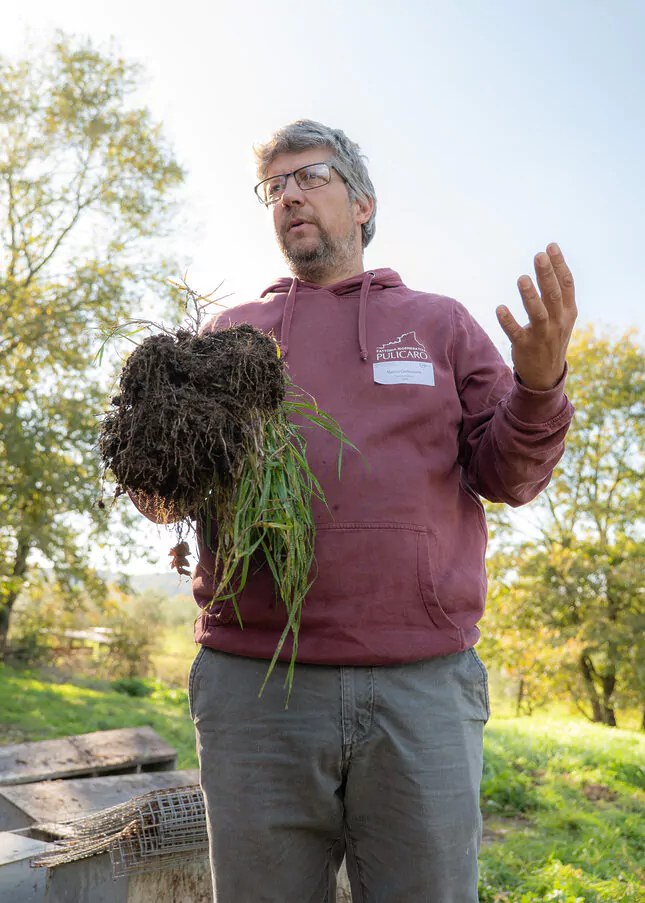
Regenerative agricultural management can rebuild the soil’s hydrological function and build resilience to both flood and drought.
On conventionally managed land, approximately 86% of rainfall becomes surface runoff during a 200 mm event. Introducing regenerative agriculture management fundamentally reduces runoff on the landscape. Under the same 200 mm rainfall event:
- Surface runoff decreases by up to 60% compared to current systems
- This corresponds to an additional 212 billion litres retained in Valencian soils across 275,000 hectares of perennial farmland, rather than lost to surface flows and erosion.
- Water infiltration rates in well-established regenerative systems reach over 70mm per hour, against 20mm or below in conventional systems, effectively absorbing up to 60% of peak hourly rainfall, massively reducing mudslides, erosion, and downstream flood impact
These outcomes are achievable within 4 to 6 years, comparable to major grey infrastructure projects. Unlike grey infrastructure, regenerative systems improve continuously rather than degrading over time, building greater capacity to manage both flood and drought with every passing year.
The upstream catchment zones of Chiva, Turis, and Utiel are the highest-priority targets for intervention, given the rainfall intensity they receive and their topography, upslope of the Júcar watershed. Regenerating these zones could deliver disproportionate benefits downstream, reducing the speed and volume of water reaching urban areas before it accumulates into destructive flows. Paired with targeted hydrological interventions such as keyline swales, small retention basins, and managed riparian buffers, regenerative agriculture in these zones offers a comprehensive, evolving flood management system.
The Economic Case
The financial argument for public investment in regenerative agricultural transitions is direct and well-supported by the Valencia data.
A targeted intervention in the highest-risk upstream zones would cost roughly €316 million over five years. At less than half the proposed water management budget, this solution addresses the root cause of flood amplification rather than its downstream consequences, and improves continuously rather than degrading over time.
The Security Case
Regenerative agriculture offers a compelling case for both climate and geopolitical resilience. EARA’s research has shown it is possible to reduce synthetic nitrogen use by 61% and pesticide use by 75%, while sourcing 100% of animal feed from within the EU. Regenerative systems substantially lower exposure to price volatility that has destabilised conventional farming in recent years. Fertiliser prices tripled following the war in Ukraine, stabilised at double pre-war levels, and have since risen a further 50% in response to the Iran conflict. Regenerative farmers are structurally more resilient to this pattern of compounding shocks. Beyond risk reduction, the approach delivers tangible economic gains, with gross margins improving by 20% per hectare alongside yield parity and greater yield resilience over time. The result is a single transition that simultaneously strengthens regional food security, reduces dependence on global input markets, and builds the long-term adaptive capacity against both climate change and increasingly unstable geopolitics. Visit our Research on Europe’s Full Productivity.
Concrete steps for the Private Sector
The private sector cannot, and should not carry this transition alone. Spain’s State Pact on Climate Emergency, the Valencian recovery fund, and existing CAP environmental allocations can provide the public framework. A cohesive response from the private sector is to co-finance, de-risk, and accelerate what public frameworks alone cannot deliver at the pace required.
Banks
Improved farm profitability and resilience, reduced default risk, increased stability of agricultural lending portfolios
Insurers
Reduced claims frequency and severity, improved loss ratios, shift toward prevention-based risk management
Supply Chain
Increased yield stability, reduced supply risk, improved long-term procurement security
Water Management
Improved water quality, increased water availability, reduced water treatment costs
Concrete Steps for the Public Sector
Redirect existing funds
Rather than focusing adaptative and preventative funding from recovery budgets to grey infrastructure, a share should enable the regenerative transition of agricultural land. This is not a reallocation away from flood protection; it is a more cost-effective and durable form of it.
Establish performance-based incentives
Outcome-based payments that reward measurable improvements in SOC, soil cover, and input reduction create an incentive for farmers to transition without requiring indefinite subsidy. Performance-based frameworks reduce fiscal exposure over time as improving landscape function reduces the frequency and severity of events that trigger public recovery expenditure.
Integrate landscape hydrology in plans
Updated land-use regulations and water plans should incorporate soil health and hydrological function as material factors in planning and flood risk assessment. For example, addressing conventional management practices that increase runoff risk (bare soils, repeated tillage) within updated regulatory frameworks for agricultural land in upstream catchments.
The findings are not presented as a complete solution to flood risk, but as evidence that land management is a material and underutilised variable in climate resilience planning. Regenerating forms of agriculture address structural vulnerabilities in the landscape that conventional flood infrastructure does not reach.
A meaningful transition can be embedded within 4 to 6 years. In a timeframe comparable to major grey infrastructure projects, regenerating forms of agriculture can deliver improvements that compound over time rather than degrading.
The report is addressed to farmers, municipalities, regional and national governments, lenders, insurers, and reinsurers. Each carries a degree of exposure to the systemic risk created by degraded agricultural landscapes. The case study aims to support more informed decisions about where, how, and at what scale land-based interventions can form part of a broader climate resilience strategy.
Get involved

William Anderson
Research Coordinator

Simon Krämer
Executive Director