Ireland's agricultural system faces import dependency, volatile inputs, and declining farmer viability. Yet regenerative agriculture offers a viable alternative: low-input systems prioritizing soil, animal, and human health with higher margins. Examining full-time dairy farms across Ireland and Europe shows regenerating forms of agriculture achieve 61% lower fertilizer use and 75% reduced plant protection with only 2% yield loss and 20% improved margins. Herds demonstrate stronger disease resilience.A national transition would cost €3.7–9.5 billion but reduce imported input spending by roughly €9.1 billion annually.
Regenerating Systemic Risk: A Case Study on Ireland
Published 5th October 2026
Download the Report Briefs
Brief to the Farmers of Ireland
Brief to the People of Ireland
Brief to the Public and Private Sector
The foundations of the current Irish agricultural system are cracking. It is supported by volatile imports, from fertiliser and feed to fruit and vegetables, while degrading the water, soils and ecosystems it depends on. As the sector grows less viable, these pressures feed into rising animal and human health costs and a dwindling flow of new entrants, leaving Ireland with weaker food security, fewer farmers and thinner farm incomes. New entrants are no longer attracted to the sector due to unstable incomes, and existing farmers struggle to pass on their farm. EARA’s farmer members have identified four connected risks at the root of this fragility, namely import dependency and input volatility (National Security), animal, plant, and human health decline (The Health Nexus), water quality failure alongside drought vulnerability (Water), all of which contribute to generational decline as the sector becomes less attractive. All four are symptoms of a fragile production model built on imports, high stocking pressure, biological simplification and narrow commodity margins. Treating each risk in isolation is only reinforcing the underlying causes.
By contrast, regenerating forms of agriculture create low-input systems, prioritise the health of soil, animal, and human without sacrificing yield. Regenerating forms of agriculture entrust Irish farmers to choose the best paths ahead for their land and communities, producing food while regenerating nature and caring for their families.
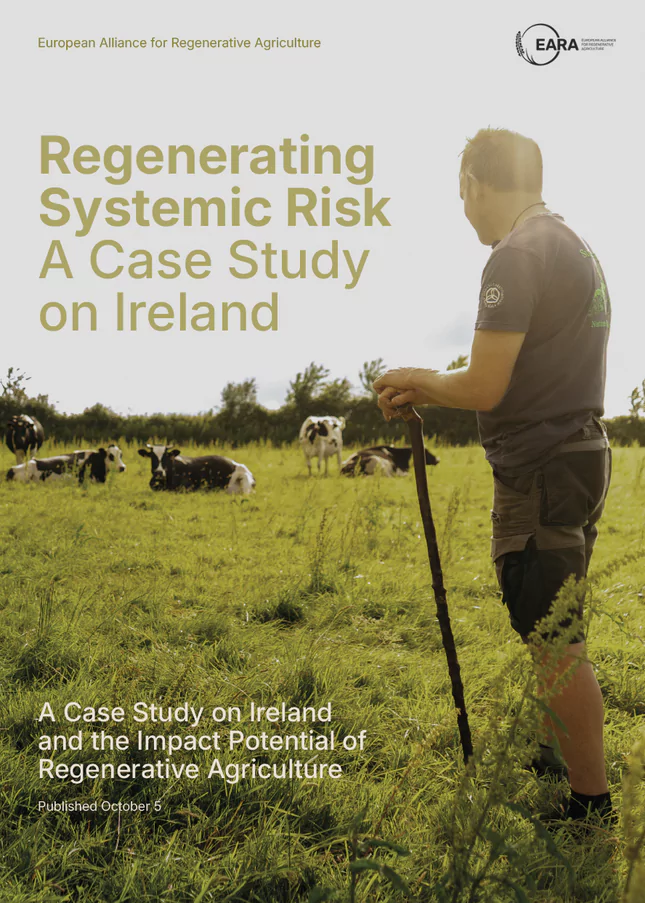
Evidence from the ground demonstrates how a different path is possible. One documented journey of change comes from Irish dairy farmer Tom Stack, whose regenerative organic dairy farm in Limerick has cut all cattle feed and synthetic fertiliser, and plant protection. The herd has also been antibiotic free since 2017, and recently returned zero bovine TB reactors despite rising incidence across the surrounding area.
Tom produces less milk per cow and per hectare than intensive neighbours, having stocked his herd for resilience, with Friesian, Shorthorn, Ayrshire and Irish Moiled crosses. Yet, he does it on a fraction of the inputs, with healthier animals and improving land. Each regenerative transition is unique and context-specific. Tom chose to make drastic changes from one year to the next, while others may move more gradually. Regardless of the pace of a farmer’s regeneration, support should be available in charting their own path, on their own terms, united in their diversity by a shared direction of travel. This is exemplified through phase 1 of EARA’s Farmer-led Study that mapped 78 farms in 14 European countries over >15 production systems, and found fertiliser volume down 61%, plant protection products down 75%, compared to national averages. Moreover, this was achieved with only a 2% yield disparity and a 20% improved gross margin.
Together, the convergence of our farmer-led data and the external literature points consistently towards the fact that regenerating systems can resemble the productivity of current models while achieving it on a structurally lower and more resilient cost base.
A national six year transition would cost between €3.7 and €9.5 billion, and can reduce imported feed, fertiliser, fuel and plant protection spending by roughly €9.1 billion, or 44% during the same timeframe, owing to reduced input costs. As these systems establish, these savings would continue to accrue, while input and import dependence would steadily decrease. Dairy-specific modelling shows a regenerative premium leaving a negligible gross economic output difference of -0.40%, cutting direct input costs by an average of 31.2%, or €337 million a year, and widening margin after inputs by €473 million.
The necessary enabling funding needed to achieve this transition is already circulating the system, and the opportunity lies in directing it toward lasting resilience. Farmers have spent over €20 billion on imported feed, fertiliser, fuel and plant protection between 2020 and 2025, the state has spent over €600 million on bovine TB eradication across recent years, despite rising herd incidence, and Ireland’s water utility Uisce Éireann has earmarked €10.3 billion in capital investment to 2029, much of it addressing the consequences of catchment pollution. These are substantial commitments, and a portion of each could be redirected upstream to address the shared causes rather than the recurring symptoms.
Inaction carries its own quieter bill, and naming it clearly helps weigh the choice ahead. The potential loss of the nitrates derogation could expose the sector to income losses of around €300 million a year. The input price shocks of 2022 and 2023 restructured farm finances right across the island. Fewer than one in twenty farmers is now under the age of 35. Regenerating forms of agriculture offer one coherent approach that works across food security, health, water quality, economic resilience and generational renewal at once. The evidence gathered in this paper is clear, and the economics behind it are compelling. What remains is the shared commitment to act together, farmers and enablers alike.
However, the public sector cannot carry the transition alone. Banks and insurers can price genuine resilience into lending and underwrite the risk of the transition years, so that farmers no longer carry the full cost. Processors and cooperatives can both reward and incentivise verified regenerative outcomes through the kind of premium modelled in this paper, while public bodies can begin to steer bovine TB research, water infrastructure and CAP spending toward performance-based payments. Place-based transition consortia offer a way to bring all of these actors together within a single landscape, pooling the contributions of those who benefit from regeneration to collectively finance and de-risk the transition for the farmers at its centre. Through this shared structure, the operational risk of the critical early years is carried between the parties rather than by the farmer alone, as detailed in the concluding appeal.