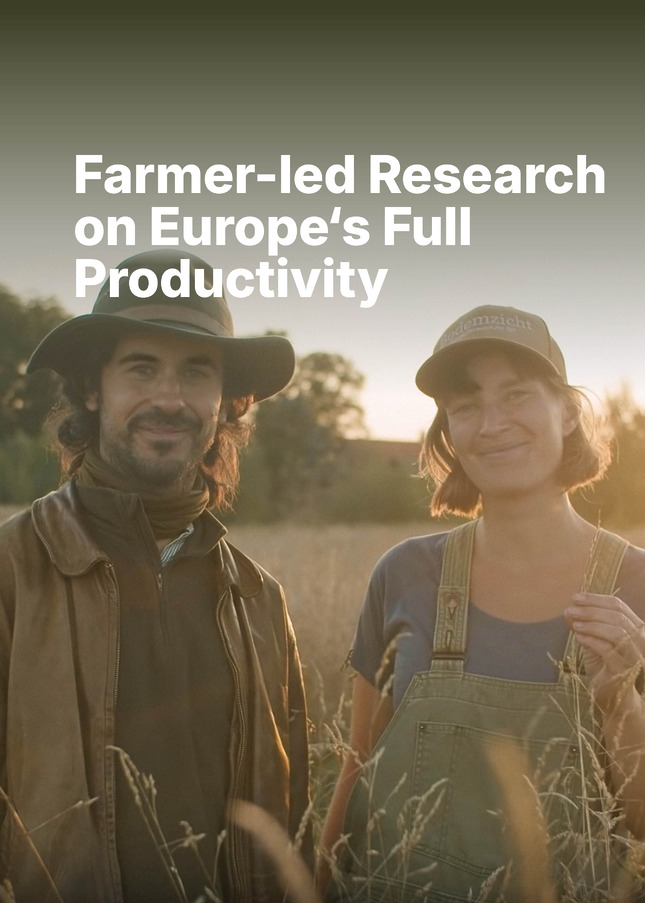
Conventional agricultural models are not fit for purpose in the face of Europe’s compounding crises in soil health, biodiversity, food system resilience, and climate stability. These challenges cannot be solved by current input-intensive farming systems designed for short-term yields.
Farmer-led Research on Europe’s Full Productivity Phase 1
Published 15th June 2025
Conventional agricultural models are not fit for purpose in the face of Europe’s compounding crises in soil health, biodiversity, food system resilience, and climate stability. These challenges cannot be solved by current inputintensive farming systems designed for short-term yields. Such models now expose Europe to critical strategic vulnerabilities: reliance on imported food, feed and inputs, untenable rural livelihoods and fragile production systems increasingly disrupted by climate extremes.
In response to this, EARA, together with cross-sectoral experts and institutions, conducted a multi-year pilot program covering 14 countries to demonstrate whether pioneering regenerative farmers can outperform conventional models, whilst improving ecosystems.
To facilitate this, the study introduces the Regenerating Full Productivity Index: a multidimensional performance metric developed by farmers, researchers and agronomists to capture the full spectrum of land stewardship outcomes: agronomic, ecological and economic. RFP builds on the conventional Total Factor Productivity (TFP) model, integrating field-level measurements, farmer-generated data, and satellite imagery, benchmarked at local, national and European levels. Unlike conventional metrics, RFP measures ecoeffectiveness, synergies and context-specific outcomes.
Regenerating the Earth‘s and Europe’s full productivity is neither an unachievable utopia nor a process on biblical time scales. Farmers are doing it today, not only without targeted support, but even against all odds. They already produce what was and often still is believed to be impossible.
These outcomes refute the assumption that Europe’s food security depends on chemical-intensive agriculture. Instead, they affirm that regenerating systems, whether rooted in agroecology, conservation agriculture, organic farming, syntropic agroforestry or other disciplines, are not only viable but already superior in most contexts. Moreover, the progressive reduction, and eventual elimination, of synthetic inputs is not only feasible but also economically and environmentally beneficial.
This study is a call to realize the following: restoring ecosystems while being productive and profitable is not a dream of some theory-lovers sitting in offices: it is what pioneer farmers are achieving on their fields throughout Europe. Let‘s support the dissemination of their techniques, for our common good.
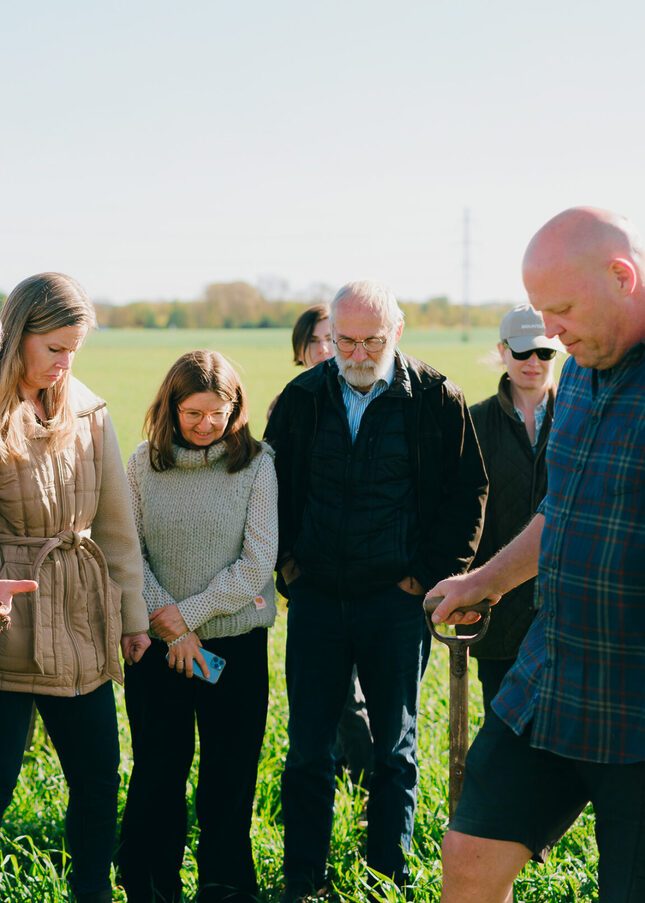
Systemic Impact: From Resilience to Renewal
A 75% adoption of regenerating forms of agriculture could more than offset current EU agricultural emissions. If scaled EU-wide, the study estimates RFP-informed transitions could mitigate an estimated 513 Mt CO₂e/year, over 1.3x of the current EU agriculture sector emissions.
By transitioning, the sector would become nature positive and climate resilient, ensuring food and fibre security while reversing ecological degradation and improving food quality and public health.
By enhancing soil health, water retention and biodiversity, regenerative systems reduce the frequency and severity of climate-induced shocks such as droughts, floods and crop failures. Investing in this resilience is cost-effective. According to the Boston Consulting Group (2025), investing 1%–2% of GDP in climate resilience could avoid losses worth 11%–27% of global output by 2100.
A Call to Action
Europe’s agri-food system stands at a crossroads. Continuing business-as-usual will deepen dependency, degrade ecosystems, increase climate risks and impose mounting costs. Already, the European Commission estimates that agricultural revenue losses could reach €60 billion by 2025, rising to €90+ by 2050.4 This study shows that another way is possible, and already happening. Regenerating forms of agriculture, grounded in the RFP framework, offer a high-impact, accountable strategy to secure our food and planetary future. The tools are here, and the time to scale them is now.
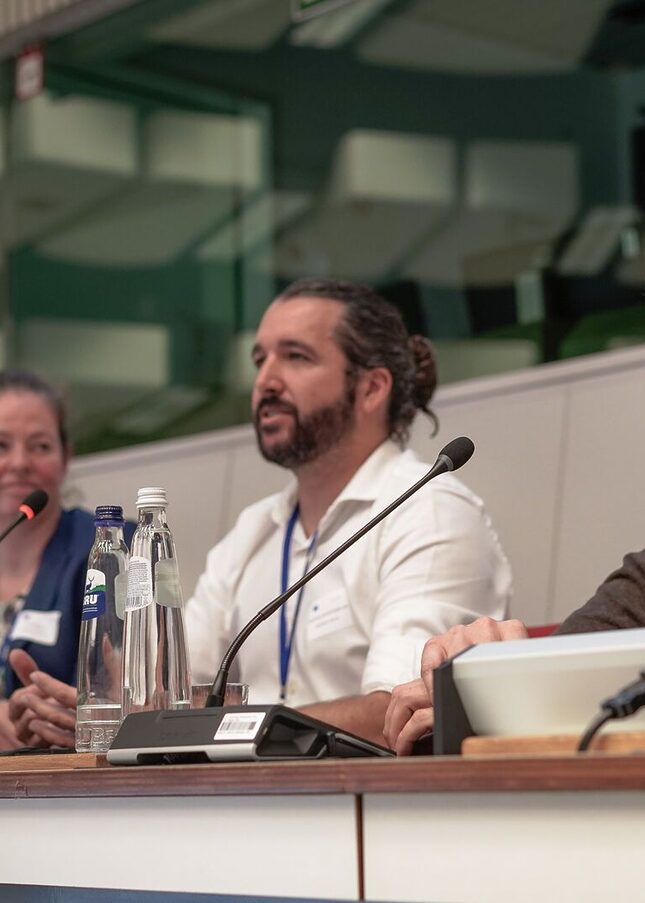
Supporting authors and independent reviewers
Theodor Friedrich (Retired-Ambassador FAO), André Leu (South Seas University), Stefan Schwarzer (Aufbauende Landwirtschaft e.V., Regenerate Forum, former UNEP author), Miha Curk (University of Ljubljana), Gunnar Thelin (Centre for Environmental and Climate science, Lund University), Ignas Bruder (Technical University Dresden), Lukas Kuhn (Technical University Hamburg), Jelle van Wesemael (Lead Data Analyst Soil Capital), William Higgins (Barka Fund), Merijn Dols (Managing Partner Now Partners), Philippe Birker (Climate Farmers), Michal Kravčík (People and Water NGO / Water Holistic, recipient Goldman Environmental Prize), Martin Kováč (Former Deputy Minister of Agriculture and Rural Development of the Slovak Republic), Luis Fernández-Carril (Academic manager of Sustainability and Professor of Ethics, Sustainability and Social Responsibility at Tecnológico de Monterrey), Markus Klein (Ekolive), Olivier de Schaetzen (Director Gens), Hamada Abdelrahman (Professor of Soil Science, Cairo University), Stephan van Vliet (Utah State University), Max Cooper (CDO Producers Trust)
Acknowledgements
The study was enabled by the financial support of EIT Food and the Jeremy Coller Foundation. The authors declare no conflict of interest.
Our deep gratitude and hope lie with the great evolving, adaptive and resilient land steward movement around the world that already has a reflexive focus and has invested its efforts in the regeneration of the health of ecosystems and rural communities – the fundamental conditions of the health of our planet and all its inhabitants.
Get involved
Get in touch with the team:
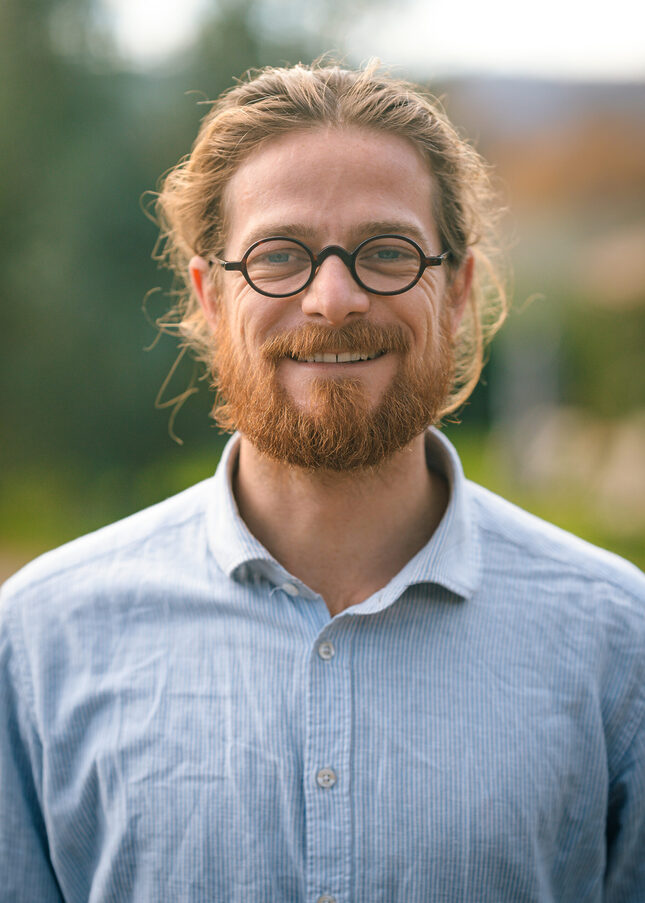
Simon Krämer
Executive Director

William Anderson
Research Coordinator